
Holy *S
What the women of the Bible teach us about holy sacred love.

What do Hannah, Ruth, Esther, Mary (the mother of Jesus), Abigail, the woman with the alabaster jar, the Samaritan woman, Mary Magdalene, the widow of Zarephath, and the persistent widow all have in common?
They all knew a something sacred about love.

It’s Mother’s Day weekend.
For some people, today feels warm and easy and smells like pancakes.
For others, it feels complicated before the sun comes up.
What brings us together, men and women, is that all of us were born to a mother.
Even Jesus was born to a mother.
After that?
The stories go everywhere.
Some of us were loved really well.
Some of us had to mother ourselves.
Some of us had to mother our siblings.
Some of us were hurt.
Some of us were helped.
Some of us are moms.
Some of us want/ed to be.
Some of us decide absolutely not to being a parent and would like to be congratulated on that clarity.
Some of us, in a moment of passion, have paired the word “mother” with an adjective we definitely didn’t learn in Sunday school.
Like… goose. What did you think I was going to say?
All that to say, it’s complicated.
But the love that we celebrate on Mother’s Day is something we can study and wonder about because love in its purest form, I’d say is the most powerful and good thing that exists. But if love is so good, why can it feel so painful?
On the the day I brought our first baby home from the hospital I gained this new ability to imagine all of the horrors of the world.
It was the same with second baby too.
Things that seemed normal and fine like crowds, and cars, bikes and sidewalks, air and outside, and regular Craft Macaroni & Cheese became villainous threats to me.
Love overtook my ability to reason.
It’s not safe.

Love can change how fast we drive, how we speak, how we wait.
And, when love changes, we might even panic a little.
Currently, I’m losing my girls to adulthood. They’re thriving and I’m trying everything I can to keep them home, keep them around, keep them close. I want to shove what was into what is, hoping that what will be can feel familiar. And all of that effort makes me a little weird as a mom and more controlling than I want to be.
No one wants to loved weirdly. To be controlled.
So, to fix that, I started playing tennis.
About eight months ago I asked Yilmaz for help.
I met Yilmaz about fourteen years ago at the YMCA. We attend the same weight training class Mondays, Wednesdays, and Fridays. Yilmaz has been inviting me to learn tennis for a long time. So in a moment of disorientation I made a decision to try something I’ve never tried before and took him up on the offer to learn tennis. I didn’t want to smother my kids. Maybe tennis could help?
Yilmaz introduced me to Jean, an incredible 86 now 87 year old athlete. She agreed to meet with me on Thursdays and I felt like she was teaching me so much more than tennis. I realized, quickly, that I had no balls.
I needed equipment (and bravery too).
Over the weeks Jean taught me how to look at the ball.
How to keep my motion going forward, because LIFE IS FORWARD.
She asked me why I felt the need to run everywhere.
Stop hurrying, start catching your breath.
Stop jumping unnecessarily. She reminded me to conserve my energy.
Why are you talking so much. Just focus on doing everything with purpose.
She even taught me how to K.I.S.S. (Keep it simple, sweetie)
I was liking every second with Jean. I took notes diligently. I practiced daily. I was growing to love tennis.
That was, until, I played my first singles match. I lost in a tiebreak.
Everyone said I should be “so proud” but I felt so off.
I’d never moved my body sideways EVER. As a seasoned marathon runner you’d think I could at the very least breathe. But I couldn’t even do that. I wondered if I should just quit while I was ahead. Jean chatted with me post match and she stayed with me in my reporting of every set, then she helped me show up the next day.
Love is like this. There is going to be a day when the fun and games will be tested.
Love doesn’t stay neat. It doesn’t stay predictable.
Life, even more so than tennis, gives us opportunities to risk love.
And the moment you love someone—you’ve already risked something.
You probably already know that love connects and completes but sometimes we feel surprised when we realize love also has the greatest capacity to wound.
It’s strong and yet so fragile.
These tensions are what makes love complicated.
So what do we do with this tension?
The Bible invites people “love God” and “love others.”
How do we do that better when love feels like a risk?
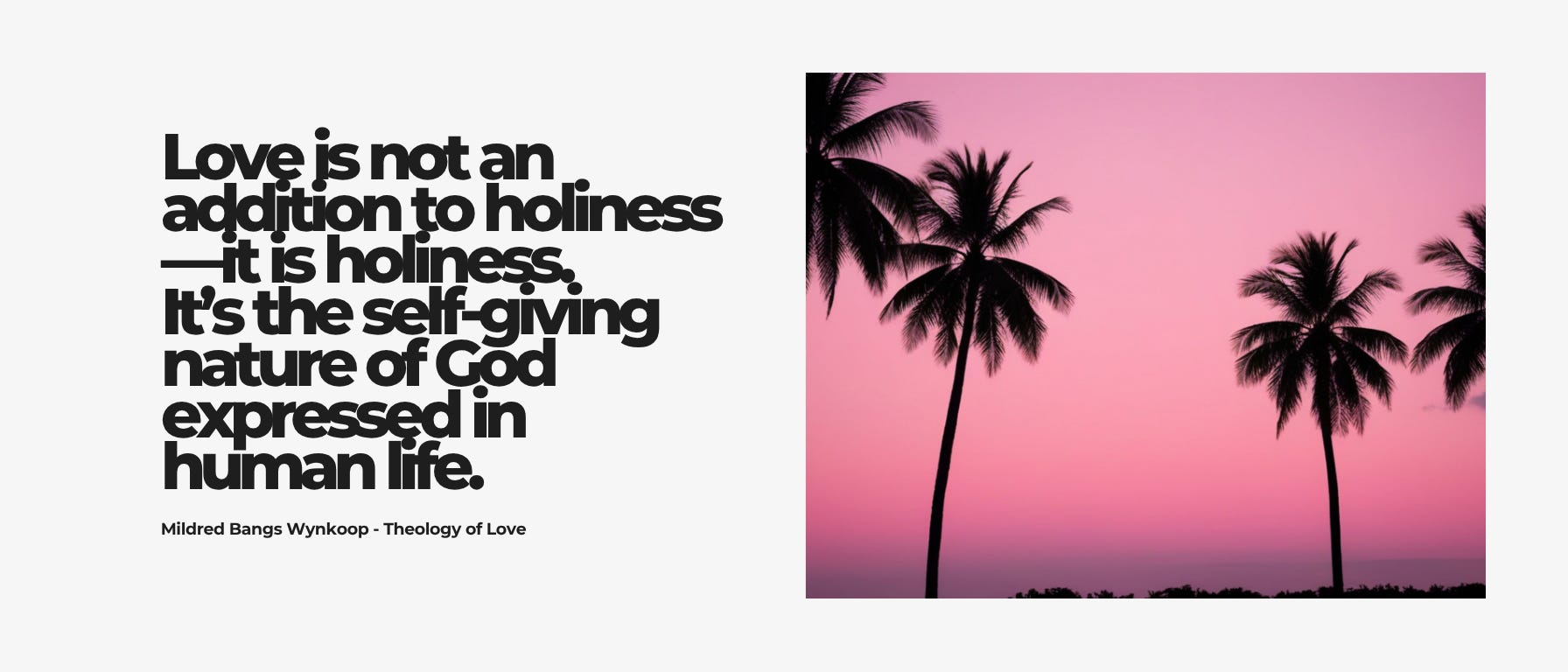
One theologian I turn to with questions like this is Mildred Bangs Wynkoop. She wrote the Theology of Love. She said:
Love is not an addition to holiness—it is holiness.
It’s the self-giving nature of God expressed in human life.
Which means love is something that sets us apart.
But it’s not the kind of love you find in the card aisle at the grocery story (even though those are really fun).
It isn’t soft or sentimental even though it’s nice to feel that way.
Love, in it’s goodness is structured. |
It’s intentional.
It gives itself away.
Which means love won’t always feel safe—being set apart or holy will probably actually usually almost always lead to places that feel more risky.
I’m really glad that when we wonder what this type of love actually looks like—we don’t have to guess. There is a Person who shows the way.
The Person of Jesus is the greatest example of selfless (and risky) love I can find.
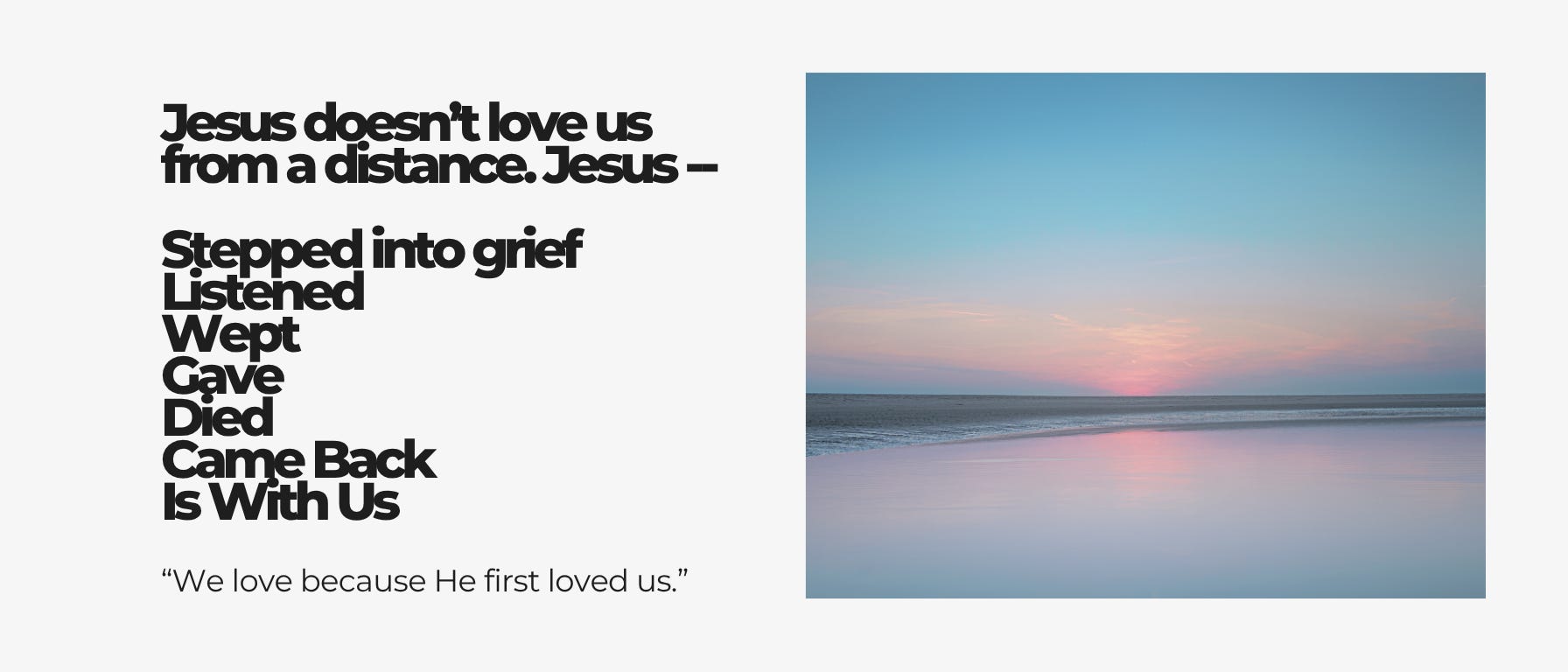
Jesus doesn’t love from a distance.
Jesus stepped into grief listened wept gave died returned is with us
The Bible says:
“We love because He first loved us.”
So love isn’t something we have to manufacture or guess about.
It’s something we receive and then reflect.
Isn’t that cool?
But choosing to receive and reflect that can feel risky for a lot of reasons.
Let’s go back to the women–how did they love when love felt like a risk?
Let’s learn from them. Dive deeper into their stories on your own.
You will find love at work.

Hannah - 1 Samuel 1:10 — “In her deep anguish Hannah prayed to the Lord, weeping bitterly.”
Hannah doesn’t filter her longing or grief. She doesn’t clean it up at all. She shows up undone. Crying. Praying. Honest. Hannah shows us love can refuse to shut down, even when it hurts to hope.

Ruth Ruth 1:16–17 — “Where you go I will go… your people will be my people and your God my God.”
Ruth was in a complicated and scary situation. She even had an exit ramp. She could’ve gone back to what was familiar, what made sense. Instead, she stayed.
Ruth shows us, love looks like choosing to love people over our comfort.

Esther Esther 4:16 — “I will go to the king… and if I perish, I perish.”
Esther knew exactly what love could cost her. She knew what could happen to her if she spoke up for others. Love looked like clear-eyed courage in her decisions. She knew the risk. She stepped in anyway to protect others.
Love doesn’t always deliver a painfree experience, does it?
Sometimes it looks like stepping forward when everything in you says, this could go badly. Esther shows us love looks like standing in for someone who needs you.

Mary (Mother of Jesus) Luke 1:38 — “I am the Lord’s servant… may your word to me be fulfilled.”
Mary’s yes isn’t small. It rewrites her entire future, reputation, plans, expectations—everything had to shift with this yes. Mary shows us that sometimes, love trusts God enough to move forward, even without all the details.

Abigail 1 Samuel 25:32–33 — “May you be blessed for your good judgment…”
Abigail walks into a tense, dangerous situation and brings peace with her.
She steps in to prevent violence. She speaks carefully, acts quickly, and changes the outcome. Abigail shows us love isn’t always loud. Sometimes it’s wise, steady, and brave enough to intervene.

The woman with the alabaster jar - Luke 7:37–38 — She wept at Jesus’ feet and poured perfume on them. She knew people were in her business. She knew people had opinions. They were likely watching her, whispering about her, and judging her completely. She shows love anyway. Her love shows us we don’t need to have it all together to show up fully.

The Samaritan woman - John 4:28–29 — “Come, see a man who told me everything I ever did.”
She could’ve stayed quiet (that would’ve been easier.) Instead, she goes on telling the truth—about herself, about Jesus, and about what just happened. It would have been so much easier to go on with her day and not to mention the “everything she ever did part” but she chose to love anyway. The Samaritan woman shows us love tells the truth, even when it’s vulnerable.

Mary Magdalene John 20:16–18 — She becomes the first witness to the resurrection.
Mary stays when others leave. At the cross. At the tomb. Even when it looks like the story is over. She stayed. Mary shows us, love doesn’t always fix things. Sometimes it just stays.
The widow of Zarephath 1 Kings 17:13–15 — She uses her last flour and oil to feed Elijah. She doesn’t give from a place of plenty. She gives sacrificially in scarcity. She gives out of almost nothing. That’s a different kind of trust. This widow shows us love gives, even when it feels like there’s not enough left.
The persistent widow Luke 18:3–5 — “Grant me justice against my adversary.”
She kept persisting. She. Did. Not. Relent. She kept expressing extravagant love despite judgment. Again. Again. Again. She has no power or status. She has persistence. She shows us, love keeps going when it would be easier to quit.
When you step back and look at all of these stories together, from diverse women in diverse situations. We we honor the words God has given us to guide us in these stories something important about love starts to come into focus: none of these women were loving from a place of ease.
They were loving in grief, uncertainty, risk, tension, in not knowing how it would turn out. And somehow—that’s where their hope and faith become most visible and real.
It’s one of the ways love becomes tangible and refined.
It’s not polished love, it’s holy.
It’s not perfect love, it’s present.
It’s not looking from a distance love, it’s right here and right now.
So, if that’s what love looks like in their stories…
what could this type of love look like in ours?
Most of us live “in love” or “in loss” and we rarely imagine the two places overlapping. But it’s in the overlap, in the ache, where love is formed.
Most of us are living in a place where something is breaking AND something is becoming beautiful. It’s in that overlap where other things are born.
Gratitude.
Generosity.
Joy.
Hope.
Bravery.
Sacrifice.
Presence.
That’s exactly where these women lived. Not outside the tension—right in the middle of it. In the ache, not above it. And this is where I think the weight of love is felt. In the decision to love even when (fill in the blank). Love is something you choose and do in the ache, in the intersection. We can more than admire what has happened in these women’s stories. We can practice.
How?
Hannah and the Samaritan woman might whisper . . .
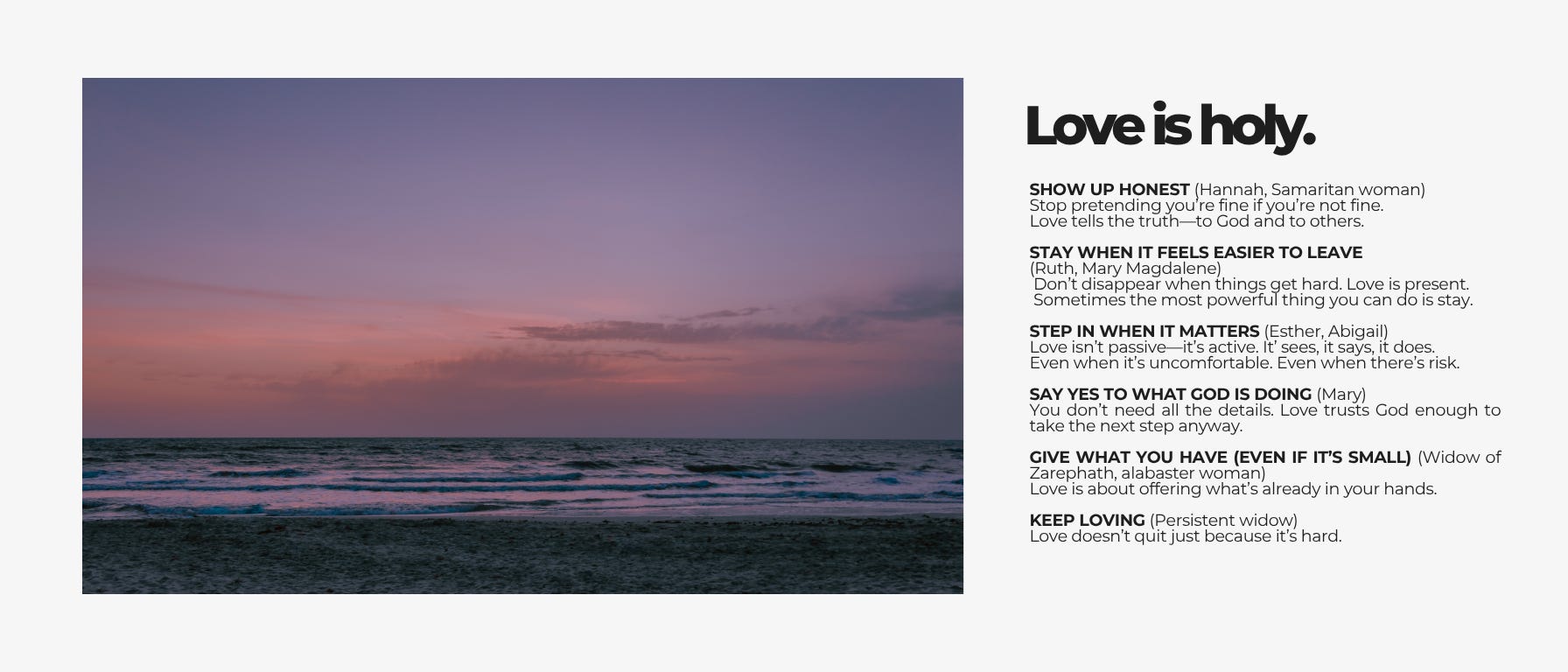
SHOW UP HONEST
Stop pretending you’re fine if you’re not fine.
Love tells the truth—to God and to others.
You can’t love well if you’re hiding.
If you’re grieving—say it. If you’re joyful—don’t apologize for it.
Ruth and Mary Magdalene might beg . . .
STAY WHEN IT FEELS EASIER TO LEAVE
Don’t disappear when things get hard. Love is in the present.
Sometimes the most powerful thing you can do is just… stay.
Esther and Abigail might plea. . .
STEP IN WHEN IT MATTERS
Say something or do something.
Love isn’t passive—it moves toward people.
Even when it’s uncomfortable, even when there’s risk, it moves.
Mary might invite you to . . .
SAY YES TO WHAT GOD IS DOING
You don’t need all the details. Love trusts God to take the next step anyway.
The widow of Zarephath and the woman with the alabaster might nudge you to . . .
GIVE WHAT YOU HAVE (EVEN IF IT’S SMALL
Love isn’t about having more. It’s about offering what’s already in your hands.
The persistent widow might repeat the phrase . . .
KEEP LOVING
When it feels boring.
When it feels impossible.
When it feels repetitive.
When nothing’s changing.
Love doesn’t quit just because it’s hard.
Wynkoop would say love isn’t just an emotion—it’s the way we live in relationship with God and others. It’s not passive. It’s not abstract. It’s active, embodied, and chosen.
Love risks the uneasy road. Want to risk it together?
As much as love is something we can enjoy it is also something formative. Want to let it form us?
It walks into uncertainty, risks rejection, and stretches beyond what feels safe—yet somehow, it always leads us closer to the heart of God. It might even make you look a type of way to a type of folks but wouldn’t we rather be the type that risks loving?
Hannah wept and still prayed. Ruth stayed when she could have left.. Esther stepped forward when silence would’ve protected her. Mary said yes without knowing the cost. Each story echoes the same truth: love may not guard your comfort, but it will always guard what is sacred. It will always lead you to what is holy.
Love will not always feel like the safest choice, but it will always be the most sacred and holy thing you can do.
I invite you into the beautiful ache that is love.
For others, for God, and especially for yourself.
God didn’t send a Counselor into the world to rescue everyone BUT you.
God sent Immanuel into the world to rescue everyone AND you.
To be with us, in the ache.
Jesus didn’t consider equality with God something to be grasped, instead he humbled himself like a servant . . . entered the ache to experience life with us.
The joy, the hope, the generosity, the sacrifice, the bravery. . . every single thing in the ache is for you to be able to experience the sacred and holy thing called love.
*this post was originally a message written for Mother’s Day at Somos Church in Lakeland Florida. it’s for the everyday saints who laugh, who cry, who love. for the creative maladjustment you participate in because of the love in your hearts. i’m grateful for the grace you give and the place you’ve given me to continue preaching.